
David Willis

How To Take A Ticket

We should all ride safely and obey the traffic laws, but let’s face it sooner or later we’re

all going to get a ticket for something. Don’t let it ruin your day. Worse things can happen on a

bike. It’s not as bad as a flat tire or an accident. Act appropriately when getting the ticket, and

you’re back on your way in a few minutes. Act wrongly, and you’ll ruin your chance of fighting

the ticket, not to mention risk escalating the event into an arrest and an opportunity to make a

few new friends downtown for the night.

Bikers can get traffic tickets for everything a car driver can as well as citations specific to

motorcycles. Common moving violations for cars or bikes are speeding, crossing a yellow line,

changing lanes during an intersection, not staying in the correct lane during a left turn, failing to

signal a turn or lane change, etc. But, bikers can also get tickets for splitting a lane (riding side

by side), loud pipes, vertical tag, and my favorite, wheelies. I don’t mean I do’em; I think it’s

hilarious that someone complains about getting busted for it. And lately, I’m handling more and

more cases of excessive speeding, like 130 and 160 mph. Man, those rice rockets really scream.

Now, here are the DO’s and DON’Ts when you get pulled over for a ticket.

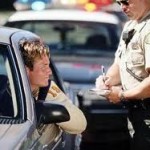
When an officer turns on the lights, DO put on your blinker and move to the right lane. If

a side street or parking lot is available, use it. If you have to drive a couple of blocks for

a good spot, this is usually permissible.

DO turn off your bike or car.

DON’T get off the bike or out of your car.

DO wait patiently for the officer to come to you. Never go to meet the officer halfway.

DON’T ever try to shake hands with an officer.

DON’T show frustration or anger.

The officer is going to ask for your “license, registration and proof of insurance.” DON’T

start digging for it until the officer asks for it, and be sure you can produce them quickly.

DO answer the officer’s questions BUT only with brief, non-committal responses.

DON’T admit to anything! I suggest answers such as “I see” or “okay.”

Q – Do you know why I pulled you over? * THIS IS IMPORTANT* Your answer is

always “No, why?” or “Please tell me.”

Q – Do you know how fast you were going? Answer – “Yes.” DON’T say your speed,

especially if you were speeding! Let the officer state how fast he/she thinks you were

going. DON’T comment, argue, debate, etc. DON’T say anything! If you must say

something, just nod you head in an “okay if you say so” way.

Q – Do you know what the speed limit is? Answer – “Pplease tell me.” Now use your

non-committal nod again. If, and only if, you’re sure of the speed limit, your answer

is “Yes,” and then be ready to state it if further questioned. But, I can defend “please tell

me” just fine.

THIS IS IMPORTANT* – DO sign the ticket! Signing the ticket does not mean you

agree with the citation; it only acknowledges you received the ticket. Refusing to sign

the ticket is a second degree misdemeanor.

DON’T make any final commentary, just sign the ticket and politely leave when the

officer is finished.

SIDE NOTE: – DON’T run from the officers! I have several clients on fast bikes that

tried to run. It usually doesn’t work, and it makes a non criminal traffic ticket into a third

degree felony. Just pull over and take the ticket, even if it means going to jail for the

night for something other than the ticket. I don’t care if you’re wanted, carrying drugs,

drunk, whatever, don’t run. It always makes your case worse. Hire an attorney and let

them work it out. It’s always cheaper and better to pull over and take the ticket!

Anytime you’re interacting with a police officer you should show respect even if you

disagree with their actions. Remember their job is to issue citations. It’s the judge’s job to

determine if the citation is valid or not. So, don’t waist your time arguing with the officer. Most

officers have already made up their minds whether you’re getting a warning or a ticket before

they approach you. So, take the ticket, and enjoy the rest of your ride. Also, you should

remember to smile; now days it’s likely you’re being video taped.

If you have a ticket in the Jacksonville area, you can find me at jaxbikerlaw.com, or

email: davidwillisesq@yahoo.com

Five Things NOT To Do When Arrested

Five Things NOT To Do When Arrested

No one expects to be arrested, but it can happen to normally law-abiding hard-working people. If you drink, you could be arrested for a DUI one day. If you are in a romantic relationship and a neighbor thinks you are too noisy in an argument, it could happen. So what should you do and not do?

1. Save Your Breath

Don’t try to convince the officer of your innocence. It’s useless. He or she only needs “probable cause” to believe you have committed a crime in order to arrest you. He does not decide your guilt and he actually doesn’t care if you are innocent or not. It is the job of the judge or jury to free you if he is wrong. If you feel that urge to convince him he’s made a mistake, remember the overwhelming probability that instead you will say at least one thing that will hurt your case, perhaps even fatally. It is smarter to save your defense for your lawyer.

2. Don’t Run

Don’t try to escape the police. It’s highly unlikely a suspect could outrun ten radio cars converging on a block in mere seconds. I saw a case where a passenger being driven home by a drunk friend bolted and ran. Why? It was the driver they wanted, and she needlessly risked injury in a forceful arrest. Even worse, the police might have suspected she ran because she had a gun, perhaps making them too quick to draw their own firearms. Most police will just arrest a runner, but there are some who will be mad they had to work so hard and injure the suspect unnecessarily.

3. Enjoy a QUIET Ride To The Police Station

Keep quiet. My hardest criminal defense cases are those where the arrested person got very talkative. Incredibly, many will start babbling without the police having asked a single question. My most vivid memory of this problem was the armed robbery suspect who blurted to police: “How could the guy identify me? The robbers were wearing masks.” To which the police smiled and responded, “Oh? Were they?” Judges and juries will discount or ignore what a suspect says that helps him, but give great weight to anything that seems to hurt him. In 34 years as a criminal lawyer and thousands of cases, I could count on one hand the number of times a suspect was released because of what he told the police after they arrested him.

4. Don’t Give Permission To Search

Don’t give permission to search anywhere. If they ask, it probably means they don’t believe they have the right to search and need your consent. If you are ordered to hand over your keys, state loudly “You do NOT have my permission to search.” If bystanders hear you, whatever the police find may be excluded from evidence later. This is also a good reason not to talk when they find something incriminating, even if it seems all is lost.

5. Don’t Be An Active Participant in Searches

If the police are searching your car or home, don’t look at the places you wish they wouldn’t search. Don’t react to the search at all, and especially not to questions like “Who does this belong to?”